By LAURA SHAINE CUNNINGHAM
I’VE always admired rustic furniture; many years ago, walking in the woods behind my house, I stepped into a clearing where the boulders and tree stumps seemed set by design in a charmed seating arrangement.
In the Region
Long Island, Westchester, Connecticut and New Jersey
“This is prettier than my living room,†I thought. Why couldn’t my living room look more like the woods? And why couldn’t my own backyard appear as artfully arranged?
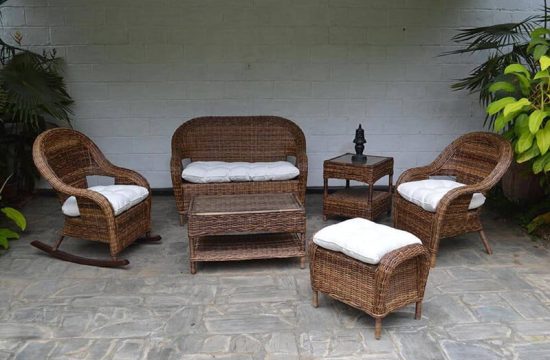
I began collecting outdoor chairs and benches made from willow and other twigs. I wanted to do even more to decorate au naturel, to bring the outdoors in and vice versa. As I looked around my overrun and stone-strewn property, it started to seem like a fresh-air furniture mart. Those tree limbs would make beautiful table legs, stumps could become seats…
Last winter, I lugged the outdoor twig furniture indoors, set it all on a white rug, and had white birch side tables built, with gray stone tops. The Robinson Crusoe in me rose to the surface, showing new scavenging and improvisational skills. I gathered slabs of stone, curious-looking branches, yards of vine. The theme indoors was “Winter Woods,†and it was striking, if a tad uncomfortable — no one said twig chairs were cozy.
My most ambitious project, though, was the outdoor stone coffee table.
Eyeing the fallen stone at the border of a defunct wall, I thought, “It’s just the right dimension for an outdoor coffee table.†The size — 4 feet by 3 feet — seemed perfect, but how could I move a large bluestone to its projected location on the other side of my house, by the backyard pool? The distance was equivalent to a city block.
It was out of the question to lift the stone, which I guessed weighed 350 pounds; it was rectangular and would not roll. I touched it, tugged it and studied it, all the while becoming more emotionally involved with its cool gray surface.
I had to have it; it would look perfect beside my swimming pool, surrounded by bent twig chairs. I imagined my guests and I seated at this table, resting frosted glasses on it. “Too cool!†as my 16-year-old daughter would exclaim.
And it was free, I thought, gloating — the best things in life were free, weren’t they? The stone was mine, with no cost other than the sweat equity it would take to relocate it.
“Drag it,†a friend suggested. “Chain it to your car.†My vintage BMW strained along the driveway, the bluestone gouging grass and gravel. At the wheel, I felt harnessed to an object that might have gone into the Great Pyramid of Giza. Perhaps years from now, people would look upon my stone coffee table and wonder how it had been lifted into place — by what magic or feat of engineering?
We may never know exactly how the Egyptians assembled the Great Pyramid, but I can confess my own secret: leverage. Enlisting a helper, I gradually raised the stone with a crowbar, while sliding support stones beneath it. Yes, the table was free, if one doesn’t count the cost of replanting the grass, replenishing the gravel and tuning up the car after the coffee-table heaving.
The stone coffee table remains my triumph. It becomes the living coffee table when I plant lobelia and succulents at its base. In summer, it shelters a profusion of flowers and vinca vine. It is a silly, ecstatic task to “water†the table with a hose on the mist setting.
Fevered by my success in stone, I turned desirous eyes to fallen tree limbs; I fell in love with white birch broken by storms. I began to collect the prettiest limbs and lug them home in my car.
I had concepts and the man to carry them to completion: the improbably named Butch Dubois, a craftsman in wood, the one who made those white birch tables. Topped with glass or slate, they are standouts, inside or on the porch.
I now risk anything to stumble down poison-ivy-covered ravines, to collect the best limbs before they rot in the forest. From wooden limbs, I graduated to my infatuation with wild grapevines.
Officially a nuisance, they have now become a resource. The vines can be twisted into rustic wreaths of the sort that cost as much as $75 at florist and craft shops. My overgrown fences are sagging with a fortune in interior-decoration materials that can be used as mirror frames or beam decorations.
THE prettiest dining room idea I have ever had was wrapping grapevines around the ceiling borders, then inserting twinkle lights, an idea I stole from a rustic restaurant in Bulgaria. The vines are best collected in early fall, but they can also serve indoor-outdoor purposes in summer, while still alive with grape leaves; nothing makes a prettier centerpiece for the table.
I arrange the wild grapevines around my largest platters to frame bunches of (store-bought) grapes and fresh cheese. For one Dionysian dinner on the porch, I twined the vines around all the chair backs and used especially verdant vine as a runner along the center of the table. It was beautiful — while it lasted. There is a wilt factor to this bit of table witchery: you have only three hours before the greenery blanches and droops. I think the expression is “died on the vine.â€
Why shop at all, I sometimes think, surveying my fresh-air market for decorative objets d’art and furnishings, where there is no need for plastic in any sense, no trip to the store and, best of all, no wait for delivery. And if an item doesn’t suit, it’s easy to return it — to the great outdoors.
Laura Shaine Cunningham is the author of “Sleeping Arrangements†and “A Place in the Country.â€