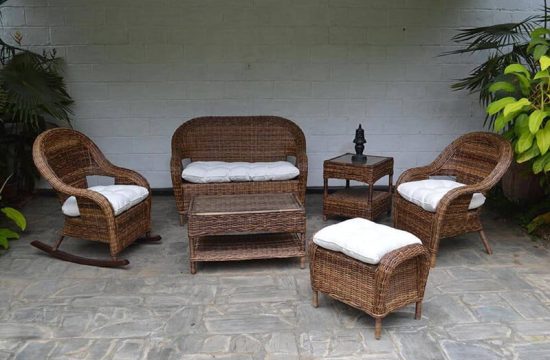
About 100 years from now, someone might lift up a chair or a table and see Pete Lovato’s initials inscribed there.
To know that his name will be burned into the wood of a fine furniture piece is enough for Lovato to keep his business, Mariah Creations, afloat. That, of course, and some machinery, skilled labor and high-quality building materials.
Lovato is a custom furniture manufacturer, designer and owner of a shop in Albuquerque – a business that requires the physical skill to handle sharp woodworking tools and the wherewithal to survive in an environment dominated by large retailers selling less expensive products.
His is one of at least 35 custom furniture-making businesses in Albuquerque, according to local phone directories. He and his wife, Theresa, operate the family business at 4408-A Menaul Blvd. N.E. along with four full-time craftsmen.
Lovato started building furniture as a kid. He built his first shelf for his mom as a Mother’s Day gift. During his summers as a teen, he apprenticed with Joe Martinez, a craftsman from Taos.
“I never thought I could get into it commercially,” Lovato said. “Once you fall in love with furniture building, designing, and see customers with a smile on their face, you are hooked.”
Lovato admits this is no rich man’s profession. “You have to love to build furniture in order to be a craftsman,” Lovato said.
Woodworkers, custom manufacturers, craftsmen, furniture or cabinet-makers – it’s a profession with different names thanks to the different tasks it entails.
The median hourly income for cabinet-makers and bench carpenters was $12.16 in May 2004, according to the U.S. Department of Labor. That income varies based on factors such as if a worker is self-employed, if they own a business, or the size of the shop in which they work.
Lovato says his four employees earn between $25,000 and $30,000 a year. About 40 percent of each piece of furniture he sells covers the cost of hiring skilled labor.
The machinery and tools are expenses he has been able to afford throughout the years. They are expensive, large, and they perform very specific tasks with wood or steel. Lovato said 35 percent of what his company earns is used on expenses such as taxes, permits and insurance.
Lovato said he has seen younger people go out of business when, after seeing a bump in income, they start a spending spree on equipment and machinery. By the end of the month, they are faced with the taxes, insurance and other bills they didn’t expect, he said.
Other custom furniture-makers have turned to mass production because they see more profit. Lovato, who prefers handmade furniture, said he spends time on the small details in his work, resulting in a product with slightly higher prices than larger operations.
“As long as I have enough to pay the bills I am happy,” he said.
Dirty job
He would likely be happier if finding good furniture builders wasn’t such a challenge.
It’s work that requires careful hands capable of handling sharp equipment, Lovato said.
“Woodworking equipment doesn’t have any mercy,” he said. “If you don’t respect the tools, they might fight you back.”
Lovato’s hands are filled with big callouses caused by hand-crafting furniture for more than 40 years. He has never suffered a major injury, but he has a scar from a time in the 1970s when he was scooping out wood for a chair and cut his wrist.
“It is like scuba diving,” he said. “They tell you never to scuba dive alone because you can get knocked in the head, cut and never be able to get any help.”
That was probably why the first thing Lovato did when he bought his wood shop was place an ornament of Jesus above the door.
Major competition
The physical risks associated with the work aren’t the only challenges faced by craftsmen. Large retailers like Ikea, American Home and Ashley Furniture – companies that produce large volumes of furniture – can sell their products at lower prices than custom builders.
“Locally, custom furniture-makers are trying to compete against a very strong international market,” said Corrales interior designer Susan Westbrook.
Lovato said that while there will always be a need for furniture, people are often duped by sub-par products made out of things like particle board that show no imperfections.
“When you are looking at a great tree wood, you are not going to get every piece perfect,” he said.
People expect low prices because that’s what they see in the market, Lovato said. The clients of a custom furniture-maker, however, are people willing to invest more money in furniture.
“I have a variety of customers, very wealthy; they just know they want something handmade,” Lovato said.
Besides quality of product, originality has driven some custom furniture-makers to build new models, styles and trends.
Scott White, who started his business, White Design, less than a year ago at 1001 Yale Blvd. S.E., saw a niche when looking for simple and functional pieces of furniture.
White now sees the competition more like a marketing challenge he must overcome.
“People don’t really know about local people making furniture,” he said.
To be successful, local custom furniture-makers said newcomers must evaluate the market and find the types of clients they want to target. Those newcomers should then build business models around their target clients using things such as a Web site, mailing lists or trade shows where they can display their work.
Trends and opportunities
Westbrook, who works with both custom furniture manufacturers and clients who buy custom-built homes, sees areas of opportunity for local craftsmen.
“People are looking for beautiful cabinet work,” she said. “Probably half of my clients are looking for custom cabinets that look like furniture.”
The cabinet-making element is something Lovato is working on. He sometimes travels to different cities to build custom doors, kitchens and other pieces.
Lovato refuses to use any rain forest wood because of the environmental impact.
Westbrook recommends that manufacturers start building furniture with sustainable materials. Lovato gives the wood he does not use to a toy-maker that builds things for needy children.
Lovato speaks admirably about his job and how he gets to interact with his customers. But he’s also worried about the future of his trade.
“Younger people (in the business) are going to see how rewarding it is talking to families in different generations, because a furniture-maker has to be knowledgeable of people,” he said. “It depresses me that this is just another form of art that’s getting lost and is getting close to getting extinct.”