By:Brief Article
In the eighteenth century, as Mark Laird so eloquently points out in this issue (see pp. 932-939), the borders between indoors and outdoors blumbed, and garden “rooms” on the great country seats of England began to echo their counterparts within the house. This maybe one reason that perhaps the earliest reference to a windsor chair (see Simon Jervis, “The first century of the English windsor chair, 1720-1820,” ANTIQUES, February 1979, p. 361) appears in an account of 1724 in which John, Viscount Perceval, described a visit to the gardens of Hall Barn in Buckinghamshire where his wife “was carry’d in a Windsor chair like those at Versailles.” In their earliest incarnation windsor chairs were mounted on wheels, as depicted in a watercolor view of Stowe executed about 1733 by Jacques Rigaud (in the Metropolitan Museum of Art, New York City).
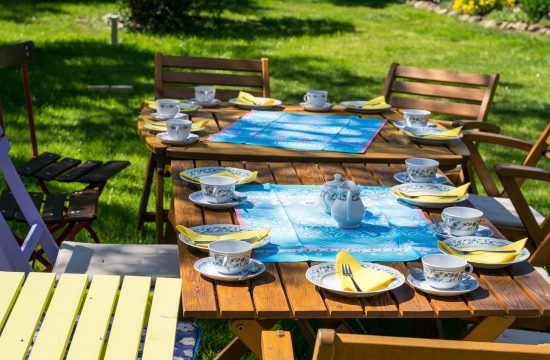
English conversation pieces, particularly those painted by Arthur Devis, depict the landed aristocracy in formal poses in their gardens, amidst mahogany tea tables, long benches, and assorted windsor chairs, much of the furniture having certainly been brought into the garden from the house. Indeed, there is at least one reference to tea being taken on the lawn atop an Oriental carpet.
The fashion for dining or taking tea alfresco traveled easily to America, where garden furniture became a fixture of the landscape, just as it had in England. Even Thomas Jefferson, who also merged indoors and outdoors at his beloved Monticello, designed a garden bench for the porches and piazzas there.