I’ve had an inkling of the heartbreak that is involved in leaving a garden, writes Elspeth Thompson
I have never had to leave a garden that I’ve created. When I moved from the tiny roof-top terraces that were my lot before making my first proper garden in London 10 years ago, it never felt like a terrible wrench. In each case the new property had more room in which to garden, and I was able to take my best-loved plants with me. A Clematis armandii that is still thriving here has survived no fewer than three house moves, and other climbers were sown from seed in the days when I used my ancient VW camper as a greenhouse, trundling it round from one side of my block of flats to the other in pursuit of the afternoon sun.
Recently, though, I’ve had an inkling of the heartbreak that is involved in leaving a garden in which a sizeable chunk of one’s life, love and time has been invested. I spent an afternoon wandering among the magical hedged and walled compartments of the garden at Guanock House, Sutton St Edmunds, Lincolnshire, that belongs to the garden designer Arne Maynard; a garden I have known since he and his partner, William Collinson, first began carving it out of the flat Fenland fields 15 years ago.
Their every weekend was spent clearing brambles, planting windbreaks and cleaning 30,000 salvaged original bricks by hand. This has rewarded them with a romantic two-acre garden of sun-lit lawns and herbaceous borders, formal pleached limes and box parterres – an ordered green oasis in the unrelenting and somewhat forbidding local landscape of open fields and sky.
The first area they got growing was the kitchen garden and it is here, one senses, that Maynard’s heart lies, with glorious glimpses of the house’s 17th-century facade behind serried ranks of leeks, beans and sweet peas for cutting. “There are so many memories bound into the paths, the lawns, the trees,” he says. “And yet it is time to move on.”
He and Collinson have decided to put the place up for sale and embark on the creation of a new garden in a different style, much more wild and free and “woollier round the edges”, in rural Herefordshire.
It is always easier to leave a place when you know where you are going. Some other friends, Wendy Booth and Leslie Howell, have just exchanged on their coastal house and garden near Rye, East Sussex, where they have lived for 25 years with its stunning driftwood terraces and harmonious mounds of sun-loving, drought-tolerant plants.
“Normally at this stage we’d be thinking of next year and have cuttings taken and seedlings rooted for planting out in the spring,” Leslie says. “But our hands are tied, as we have no idea where we’ll be by then.” They hope to take a few of their most treasured plants with them, to kick-start the creation of a new garden. “I like the idea of bringing something of this place with us,” he reflects.
Sometimes, the leaving of a garden is bound up with grief at the loss of a loved one. When Mirabel Osler suddenly lost her husband Michael, with whom she’d made the tree-filled, rose-festooned garden immortalized in her book A Gentle Plea for Chaos (Frances Lincoln £7.99), she had absolutely no qualms about creating a brand new, easy-to-manage garden for herself. “Leave while you still feel good about it, before the garden you loved together becomes a burden,” she counsels. “And never look back. Immortality and gardens don’t work.” Sixteen years on, her narrow town garden in Ludlow is every bit as fêted as the one she left behind.
Arne Maynard has decided not to take anything with him. “It’s all staying put. I’d rather make a clean break. Besides, everything was chosen specifically for this garden. I don’t want to be burdened at the new place with the obligation to fit it in.”
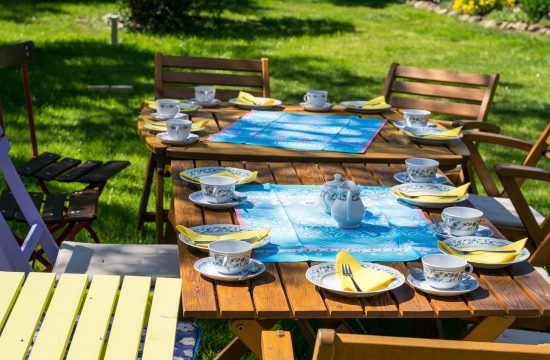
It also, he says, feels right to leave the garden intact “rather than with gaps in the borders and an empty space where the chairs and table used to stand”. He might just allow himself some seed from a rather special cyclamen, but will leave the parent plant for the garden’s next owners to enjoy.
Arne Maynard’s house and garden, complete with garden furniture, pots and other features, is for sale at £1 million through Jackson-Stops & Staff (020 7664 6646).
What to do this week
Feed roses one last time with a specific rose fertilizer high in potash to encourage the formation of more flowering wood for next year’s blooms. Feeding after July encourages late growth which is vulnerable to frost.
Continue to sow lettuces, radishes and spring onions until the end of the month for cropping in the autumn. Endive and radicchio for winter and spring salads can be sown in trays or direct in drills half an inch (1cm) deep.
Water cacti and succulents fortnightly (or when compost is dry) during the growing season, and feed monthly with a tomato feed diluted to half-strength. Keep Christmas and Easter cacti away from direct sunlight in summer, as it can scorch the leaves.