By THE KOVELS
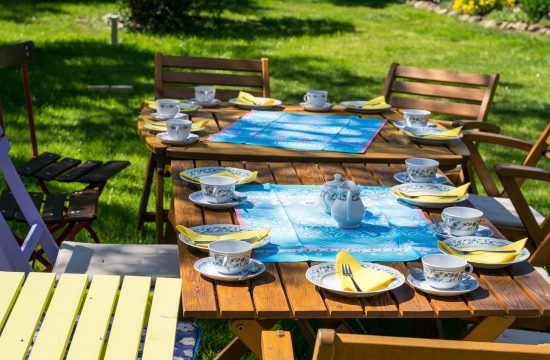
Garden furniture has become more popular in recent years because more people have patios and decks.
By the 1800s, furniture was often used in the garden. This furniture was made to blend in with the greenery. Pieces were often made from iron shaped like vines or branches. Carved marble benches were used by the wealthy, while rough log benches were used by others. Soon potters started making replicas of tree stumps or trimmed branches that could be used for seats. By the 1890s, willow and other flexible tree branches and roots were cut and assembled to make one-of-a-kind chairs for use in a yard.
Al Capone, the infamous gangster, had a house called “The Hideout” in northern Wisconsin. A table and chairs made from tree roots were in the yard until they were later purchased from Edward O’Hare, an accomplice of Capone. The chairs were sold in May at a Leslie Hindman auction in Chicago. The table brought $10,200, the large chair $7,200 and the smaller chair $3,360.
Q. I was involved in racing Soap Box Derby cars more than 50 years ago, when I was between 10 and 15 years old. What are old cars worth? Is there a museum that might want them?
A. The annual All American Soap Box Derby championship is being held today at Derby Downs in Akron, Ohio. The gravity-powered amateur car race, for children ages 8 to 17, dates back to the Depression era. The cars that win the final races (there are several divisions) are displayed in Akron’s Soap Box Derby Hall of Fame. The Smithsonian owns at least one, donated by the 1961 Connecticut champion, and some winners around the country have donated their cars to local museums. We have seen a few old soapbox cars offered for sale at prices ranging from under $100 to more than $250.
Q. Months ago you pictured a pottery lamp base decorated with lovebirds that was unmarked but attributed to Muncie Pottery of Muncie, Ind. Then recently you mentioned a glass lamp base in the same pattern made by Consolidated Lamp and Glass Co. of Coraopolis, Pa. I have a pair of pottery lamp bases in the same pattern, but they’re marked “Stangl Pottery.”
A. Reuben Haley (1872-1933) is the reason for the mystery. He was a major American glass designer and worked for several glass manufacturers before he formed his own design and mold company in Beaver, Pa., about 1925. That was the year he visited the International Exposition in Paris, where he saw the designs of French glass artist Rene Lalique. A Lalique design featuring lovebirds inspired Haley to create his own lovebirds design. He licensed the design and sold it to Consolidated Glass, Muncie Pottery and Stangl Pottery of Flemington, N.J. We now think only Stangl made pottery lamp bases in the lovebirds pattern. Muncie made lovebird vases in several styles and sizes.
Q. I have an old Buick Dynaflow Drive neon sign 22 inches high by 33 inches wide. The glass is perfect, although some of the finish is worn. I have been told the sign is valuable. What do you think?
A. Collectors of automobile advertising memorabilia might pay $1,000 or more for your sign. It dates from the late 1940s or ’50s and advertises the world’s first conventional torque converter automatic transmission, dubbed Dynaflow Drive by General Motors. The signs, made by Zeon Signs of Albuquerque, N.M., were marketed to Buick dealers for $42 each in 1948.
Write to Kovels, The Ledger, King Features Syndicate, 300 W. 57th St., New York, NY 10019.