by Margurite Gordon
Last Sunday, seating at a table was discussed and this included the vexing (for some) question of whether
husbands and wives (or men, women and their “partners”, a word now very much used in many countries), should be seated beside each other.
I showed diagrams with seating-both for six people and for eight people-that alternated men and women and also discussed the seating of the guests of honour.r.
I ended by suggesting that if the seating became too problematic, one should forget the whole thing and just have buffet meals. But would some enterprising men decide to seat themselves at your splendid buffet table? May I suggest that some certainly would. I have seen this done.
Why do some men just plonk themselves down at the table? This is because men-not women-really do not seem to have any laps and they need to place those plates somewhere and (sorry, ladies), the hostess has forgotten to remove the chairs from around the table and people are dodging the chairs as they weave about the table where some men will seat themselves when they feel all the guests have finally exited.
But gentlemen, please do not sit at this table. Be innovative and find somewhere else to sit, unless the hostess insists that you stay where you are and tries to close her eyes to all the other guests trying to navigate their way around you. The hostess can try to find small individual tables or trays if the guests are not that young anymore, but only if the function is small.
The buffet is much more flexible than a sit-down dinner or lunch, and is great for making your guests feel right at home, especially if you have a minimal amount of staff. Of course, be prepared for spillage and perhaps breakage if you do not have enough seating. At really large parties, anywhere may be used for people to “cotch” (this is a wonderfully explicit Jamaican word, which when loosely translated means “leaning against for support”). So guests can “cotch” on a railing or on the arm of a chair.
The buffet, it is said, started in France around the 16th century and spread throughout Europe. The word “buffet” was and still is a piece of furniture, on which food was and is, carved and displayed. This type of buffet was referred to as the Court Cupboard at that time in England. Now we all still use the more modern buffet that usually has shelves and doors.
The food you will serve at your buffet luncheon, dinner or supper is also to be selected with care. If you are going to have soup, then it should be served in deep “cups” with handles and though your main course can be a selection of really what you wish to serve, one needs to be reminded that at large buffets, the fork is supreme as your main piece of cutlery, and the knife is usually no where to be seen. But that is only if you do not have enough tables and seating for everyone.
My “beef” is with the caterers or hostesses of large buffets and sit where-you-will seating, and it concerns this fork-alone tradition. Of course, the guest has to have the fork in the right hand and hopefully firmly grip the plate with the left hand while still balancing the glass of wine (or whatever) somewhere. But if meat-whether pork, chicken, or beef-is being served, it is imperative the slices that the guest has selected to put on his/her plate are small (quite small) and, I might add, tender. I mean small enough to be speared by the fork and taken to the mouth without fear of being choked.d.
More often than not, the guest may be forced to hold the meat with fingers of the left hand and try to “cut” the meat with the fork. The cocktail buffet is a very popular way of entertaining now, and here everyone stands, consuming delicate morsels of mostly finger-foods. What is also in vogue are “drop tables”, which have graduated from being just a place to rest those used glasses or plates, to new heights (both figuratively and literally), and have now turned into “bistro” tables, where one can stand comfortably and, because they are taller, a slight, standing “cotch” can be effectively done whilst one eats.
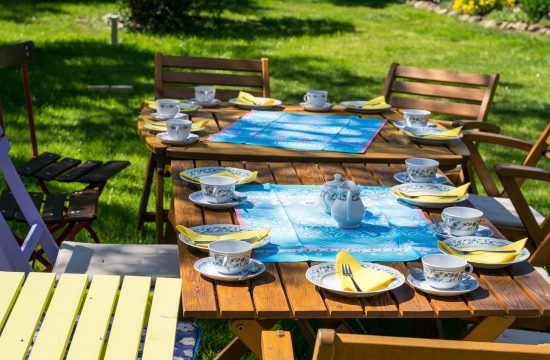
But the buffet service I like best is sometimes called “a la russe”. The guests will be seated at a conventional dinner table setting; they will then rise after the first or second course and take themselves to the buffet table or sideboard, help themselves and then return to their seats. These seats do not have to be at one table, there can be many small tables scattered around of various sizes and shapes. For large “party” parties, it is not practical to leave the cutlery on the tables because different people will be coming and going, so the table tops, except for the decoration which is usually the centrepiece, can be left clear, and the guests themselves will bring and collect their cutlery and napkins. For smaller parties where cocktails will be served in a different area, the tables would already have cutlery and napkins.
Can the hostess serve their meal with a mixture of different types of service for different courses?
Yes, she can!
Next week, a little more on different types of service.
Please telephone in your questions and comments to Marguerite Gordon at 632-3958 on Mondays to Fridays, or send e-mail to margor@trinidad.net.